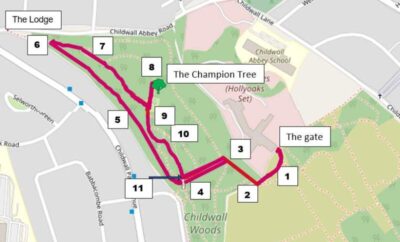
This walk will take you into the heart of the ornamental woods, where Holly and Oaks are real, and Lime is a tree name, not an address.
This beautiful Local Nature Reserve was once the grounds of Childwall Hall, the prestigious residence of the Gascoyne family and we have a lot to thank them for.
This path will take you down the carriageway to the main entrance on Childwall Abbey Road and then bring you back through the Rhododendrons, past large veteran trees, and a ‘folly ‘. If you fancy a short detour, you can visit a rare variagated oak tree, the champion of Lancashire. It is all here.
It could take approximately 45 minutes.
1. The Concrete Path
The walk begins as you step onto the top of the concrete path.
This path is a relic from the time when heavy lorries would travel up the hill to tip their load. The history of the site tells us that Childwall Fields used to be called Childwall Park until it was used as a landfill site in the 1960s. The sharp slopes are a clue to that dark time. But this walk will take you away from the fields into the woods.
Turn right to walk up to the Top Field.
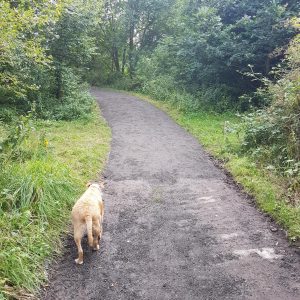
This steep path takes you to the top field.
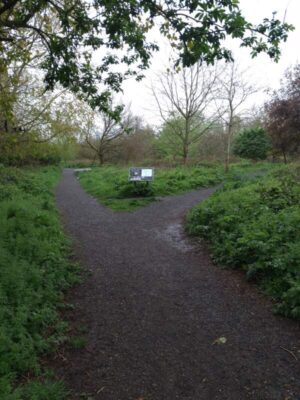
Have a look at the Interpretation Board as you go past. It is full of interesting information.
2 Turn right at the interpretation board.
This is the wildflower area of the field, created on what was once impassable mud.
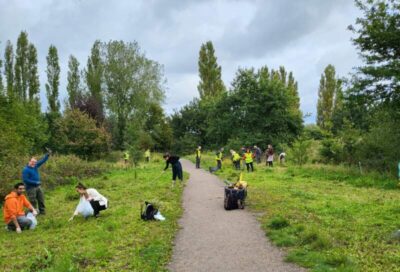
The Friends of Childwall Woods and Fields Volunteers. Creating a wildflower area.
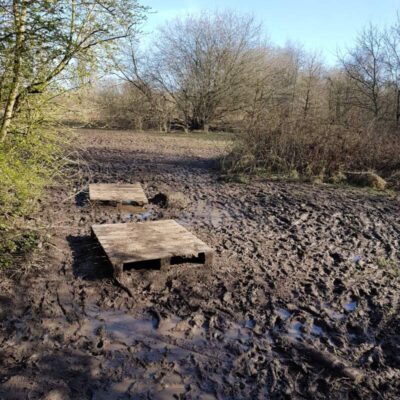
The wildflower area before the Access and Habitat project in 2021
The Friends of Childwall Woods and Fields (FCWF) won a large bid in 2021 to improve and introduce new habitats and to create better access for pedestrians and wheelchair users. You can read about the transformation created by the funding on our website, Habitat and Access Improvement Project but you will be walking on one of the paths created by that funding.
The path turns sharp right, across the Ha-ha.
The Ha-ha is a ditch with a wall on its inner side below ground level, forming a boundary to the garden so that sheep, etc., could not get near to the house, but there was no fence interrupting the view.
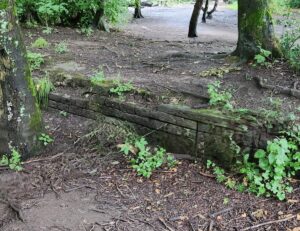
The remains of the Ha-ha around Childwall Hall. It can be seen in Lime Pictures site, in a few places.
The Ha-ha was bridged to make access easier on this, the bottom path.
Once you have crossed the Ha-ha, follow the path to some of the largest trees in the woods. You are in Childwall Woods.
3. Childwall Woods
Nature never intended a wood to grow here. The soil is thin on the Bunter Sandstone that underlies the whole region. This was once Childwall Heath with bushes and brambles, but not large trees
Our beautiful wood is manmade, planted by the owners and tenants of Childwall Hall through the centuries. The planting began roughly 350 years ago when the first Childwall Hall was built, and sweet chestnut trees were planted for their nuts, which were used as flour. Beech and fast-growing birch were planted to create a wood quickly for hunting pheasants and for a pleasant place to walk. They certainly succeeded with the latter.
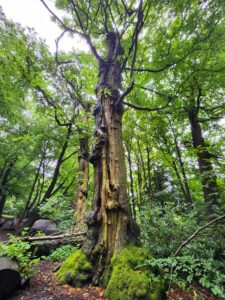
Very old trees with hollows, rot and peeling bark are irreplaceable habitats for hundreds of species of fungi, invertebrates, small mammals, and birds. This tree has them all.
You will notice an old, large Sweet chestnut tree, which is probably 350 years old. Its girth is 4.60m, which makes this a large veteran and most likely one of the first trees to be planted near to the hall.
Its column of rot is a wonderful, irreplaceable habitat for fungi and invertebrates, not to mention the nut hatches and tree creepers that nest in it each year.
Walk on towards the carriageway, and you will see the History Board. An Interpretation Board, which was created in conjunction with Hope University’s History Department. You will want to stop for a moment to read the fascinating information about Childwall Hall and its owners.
Turn and walk into the carriageway
3. The carriageway
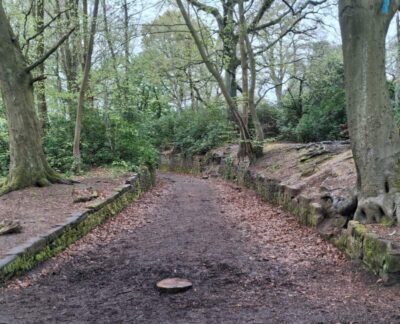
The carriageway was created in the early 1800s by the owner at the time, Bamber Gascoyne Jnr.
He was MP for Liverpool and engaged John Nash to remodel the Hall. The carriageway was dug and cut at around this time. The History page on the website will tell the story.
As you walk down the carriageway, you will see sections where it was cut through the sandstone and sections of well-constructed brickwork illustrating the importance of this route.
Constructed by craftsmen, these walls have held back the soil for hundreds of years and are still a beautiful sight to see.
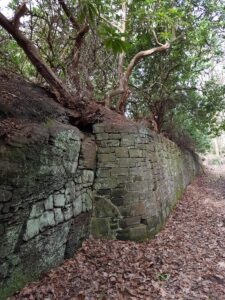
The curve to create a passing place.
4 A site of Geological Importance
The steep sides of the carriageway expose the Bunter Sandstone, formed millions of years ago.
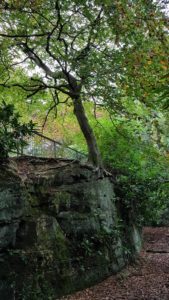
The sheer walls show how, millions of years ago, they were laid down in a warm sea where our woods now stand.
This is recognised as a Regionally Important Geological Site (RIGS)
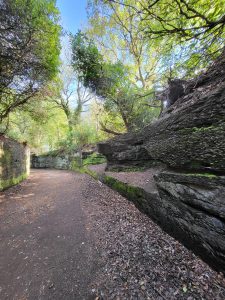
As you walk through the carriageway, you will see many signs that this was once an important route through the grounds and up to the door of Childwall Hall.
At the beginning, the walls are low, and the trees have pushed their way over the top, making this a leafy summer walk.
The floor is solid Bunter Sandstone, covered with layers of porous stone to help with drainage, laid many years ago. It’s hard to understand how long such a feat would have taken without powered tools. A significant engineering project and a work of art
Recently, decades of leaf litter has been removed to make this a good route into the heart of the woods, and you won’t need your wellies.
6. The Commemorative Tree
At the end of the carriageway, you will see a large purple-leafed beech in the middle of the path. This is the tree planted to commemorate the opening of the Woods and Fields to the public in 1967.
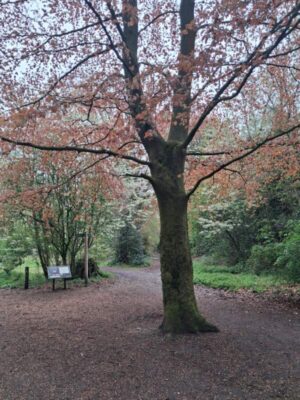
Next to the Commemorative tree, you will see another interpretation board. If you stand in front of the board to read it, your next path is on your right.
It runs next to the carriageway you walked along.
But: Take a minute to look around.
Beautiful and sometimes edible fungus appears and disappears according to the time of year, but if the fungus isn’t there to catch your eye, then maybe the Peacock butterflies will be, or the Speckled Wood varieties.
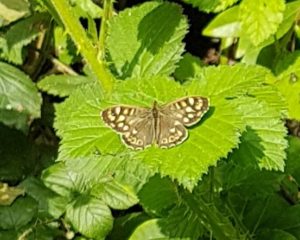
Maybe it will be the blue of the Bluebells that will make you smile, or the rapping of a woodpecker, or meeting a squirrel eye to eye.
There will be something.
7. Walk forward on the left-hand path.
There is a horse chestnut tree on this path right in front of you as you walk. Its branches have been chopped, and there is a wide column of rot at the base. It was dropping branches and became quite dangerous, and would have certainly been chopped down except it comes alive at dusk as bats fly out of its hollows. Even dead trees are irreplaceable habitats.
Follow the path forward past the tree onto the path with the Rhododendrons on either side. Now overgrown and wild, but once they were trimmed and nurtured as ornate garden specimens belonging to the grand Childwall Hall.
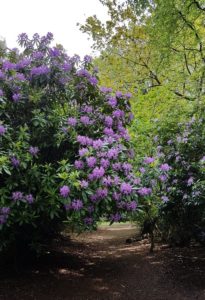
Don’t be fooled by their winter colours. Spring dresses these old ladies in their Sunday best.
Follow the path through the Rhododendrons past the large veteran beech on your left.
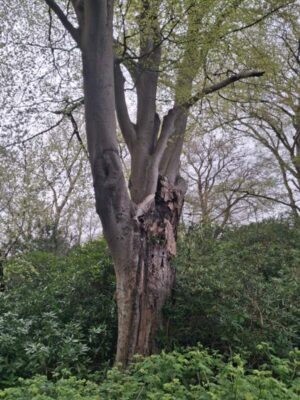
Scarred from losing its branch 6 years ago, but now exposing its heartwood to the fungus and woodboring beetles, which have taken up residency in it.
Your path will bring you to a grass triangle with bird feeders on a large Lime tree. This is where you will want to take a short detour to see the Champion tree. Walk between the feeders and the bench, and you will see a path to your left. Follow it to the tree surrounded by branches on the ground. That is the Champion Tree.
8. The Variegated Oak
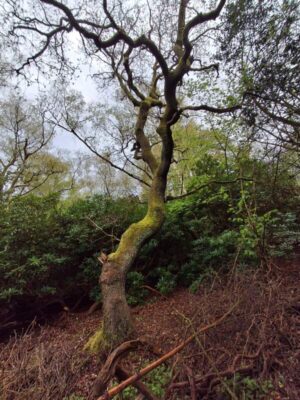
A rare tree, discovered on 5th June 2020. Recorded by the Tree Register of Britain and Ireland (TROBI) as the 13th largest variegated common oak in Britain and Ireland. A Champion tree for Lancashire. (The TROBI has kept the old counties)
Yes, it’s hard to believe that a tree so ordinary in the winter can be so special, but you should see it in the summer when it has its variegated leaves on it.
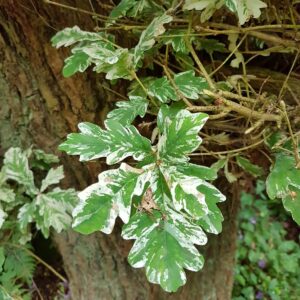
A creamy white ripple throughout each leaf. And just like snowflakes, every leaf is different.
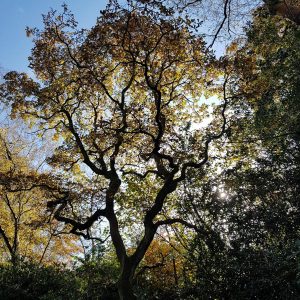
With the setting sun behind it, you can see it’s special.
A manmade tree. You can see the graft in the trunk. Only a very wealthy person would have been able to afford such a tree. Maybe the Brocklebank family had it planted there for their pleasure when they were tenants at the Hall. We will never know.
Walk back to the bird feeders and return to the main path through the woods to continue your walk.
9. The Folly
On your left, you will notice a set of steps cut into the rock to take you down to The Folly. For most walkers, it will be passable at all times of the year.
But be careful.
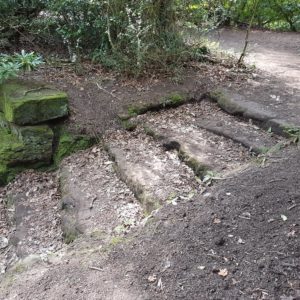
You can follow these steps down to another set of steps that will take you around The Folly, known locally as Monkey Island.
It is thought that the folly was built to impress visitors and for no practical purpose. When first created, it would not have been shaded by large trees and Rhododendrons as it is today, but would have been open and bright, a cool spot for an interesting afternoon walk. Which it still is today.
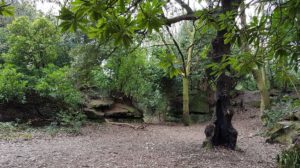
It is a magical manmade feature of the site.
Was it cut into the rock or built using huge slabs of sandstone?
What do you think?
The path to the left is often the best and the driest way around while you explore the many interesting features, since FCWF ‘Diggers’ put the stepping logs in.
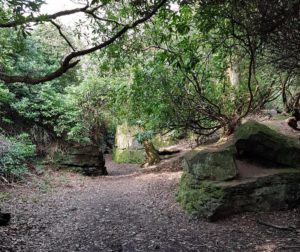
There are some wonderful natural features in The Folly, besides those made by man.
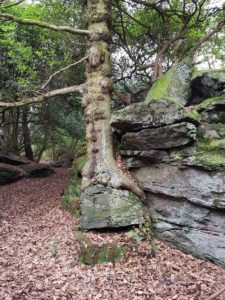
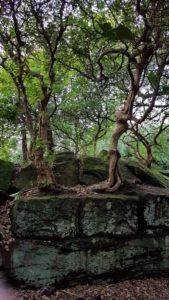
The trees in the Folly are wonderfully strange and show how resilient nature can be in establishing a foothold in an unlikely and unfriendly environment.
Walk straight through to the bridge.
10. The Bridge over the Carriageway
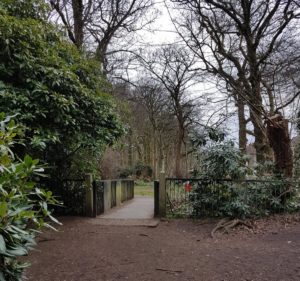
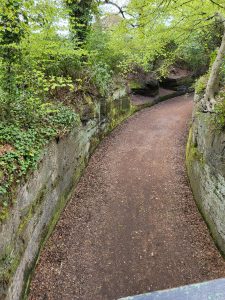
Here, the Bunter Sandstone is cut away to create a gentle curve around to reveal Childwall Hall to its visitors.
Dont cross over the bridge here, walk down the main path keeping the carriageway on your right.
11. The path down the Hill
Looking down the path, you will see a fallen tree right across the path in front of you.
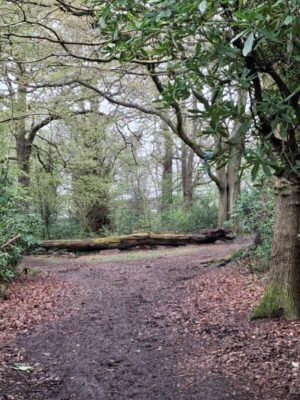
On the far side of the tree is the path that will take you back to Lime Pictures gate, but before you go you may notice the cobbles in the ground that tell us this used to be a path made for the Gascoynes to keep their feet free from mud. There isn’t much left of the path from 300 years ago, and walkers through the centuries would certainly see a different wood, Different every season, different every day.
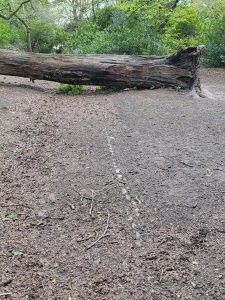
A tiny hint of the pathway that was used by the Gascoyne family as they enjoyed their woods.
Once you are back on the bottom path, follow it to the right, and you will pass the end of the carriageway and the sweet chestnut trees. Look out for bluebells in this wooded area, making the most of the sun before the leaves appear.
Go quietly, as this is a favourite spot for woodpeckers too, as soon as a walker has passed. But even if the woodpeckers are hiding and the bluebells have finished, you will still hear the incredible concerto of birdsong which hasn’t changed for centuries. You just have to listen.
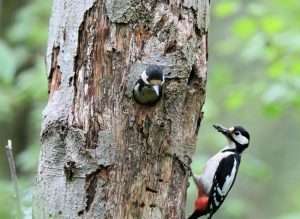
B Cameron
.