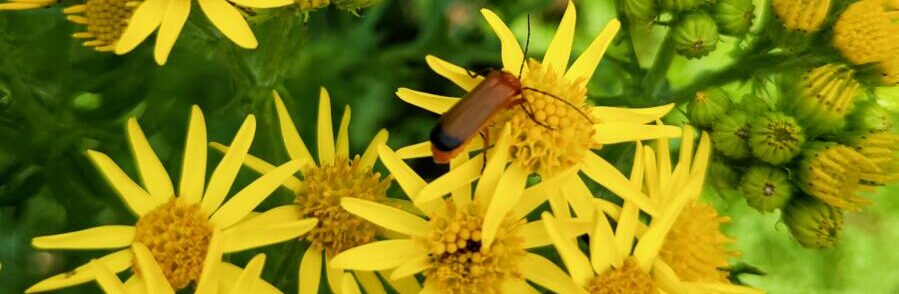

When people think of the wildlife of Childwall Woods and Fields, one of the first things to spring to mind is the birdlife. The current site list records 70 species showing that the rich variety of habitats supports a diverse community of birds. Old beech woods, younger deciduous tree plantations, bramble, grassy areas, and young scrub all contribute to a matrix of different places for birds to use.
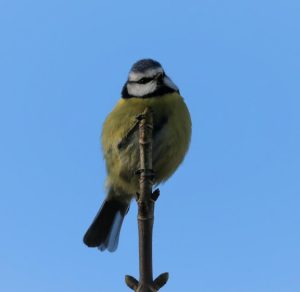
Blue tit – Feb 2021 – Danny Carmichael
In order for us to gain a better understanding of the birdlife of the site, David Holland, (FCWF President) committed himself to making 100 survey visits to record the birds in 2019 and he has continued this every year to 2025, a sign of real dedication. David’s records have been supplemented by sightings from a number of keen birders who are adding to the site tally, including all birds seen on the site and in the air over the site.
Walks through the woods and fields generally take 1½ – 2 hours each, at different times of the day and in various weather conditions. Seeing and recording the different birds presents many challenges, starting with the observer’s own skills at identification.
As the leaves of the trees and scrub plants develop through spring into summer, it becomes more difficult to see the birds, and the songs and calls they make become increasingly important for identification purposes. A number of bird song apps have become popular for people who are new to birding, particularly Merlin. These apps can be useful but they need to be used with care especially if the app suggests a rare bird has been heard. The apps are often wrong in such cases.
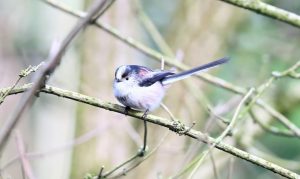
Long-tailed Tit – March ’21 – Danny Carmichael
70 species of birds have been recorded between 2019 – 2025
Birds shown in bold may be seen throughout the year.
S denotes summer visitors. W shows winter visitors. F shows birds seen flying over.
blackbird
blackcap S
black-headed gull F
blue tit
bullfinch
buzzard
Canada goose F
carrion crow
chaffinch
chiffchaff S
coal tit
collared dove
common gull F
common snipe
coot
cormorant F
dunnock
feral pigeon F
fieldfare W
goldcrest
goldfinch
great spotted woodpecker
great tit
greenfinch
grey heron
grey wagtail
greylag goose F
herring gull F
house sparrow
jackdaw
jay
kestrel
kingfisher
lapwing
lesser black-backed gull F
lesser whitethroat S
linnet
long-tailed tit
magpie
mallard
mistle thrush
moorhen
nuthatch
peregrine F
pheasant
pied flycatcher
pink-footed goose W F
raven
redpoll W
redstart
red-legged partridge
redwing W
ring-necked parakeet
ring ousel
robin
siskin W
song thrush
sparrowhawk
starling F
stock dove
swallow S F
swift S F
tawny owl
treecreeper
wheatear
whitethroat S
willow warbler S
woodcock
woodpigeon
wren
The changes in the bird life of the woods and fields
Nationally there has been an overall 18% decline in wild birds over the past 50 years, and a 62% decline in farmland birds, mainly due to habitat loss, agricultural intensification and climate change. One change we have seen is the decline in the population of linnets which used to be common here. Not any more. But it’s not all bad news. One bird we never saw until five years ago was the ring-necked parakeet; now these are noisily apparent everywhere reflecting their spread across south Liverpool. And introducing new habitats has also brought benefits; already the new ponds have attracted mallard, coot and moorhen.
Birds are mobile! It sounds obvious and some of the seasonal changes are clear to see and hear: spring sees the influx of songbirds, especially warblers, moving in to breed from southern Europe and Africa. These leave in the autumn. The winter then sees an influx of thrushes, such as redwing, and finches, including siskin and redpolls, moving south from northern Europe in search of our warmth(!) and food. It is these big seasonal migrations that explains why some unusual passage migrants have been found here, such as the mountain species grey wagtail and ring ousel, or oddities such as wheatear and flycatcher. And we have the joy of seeing (and hearing) large flocks of migrating geese flying over.
Other bird movements are less obvious. In the list above we have highlighted 29 bird species which may be seen throughout the year – but a resident species is not the same as a resident bird! A blackbird we see here in the winter may not be the same bird we saw in the spring. Research shows that many of our breeding birds move to the south of England or the near continent for winter, and are replaced by birds of the same species moving in from Scandinavia.
BIRD NOTES
Buzzards (1 or 2 at a time) are present all year. Sometimes they have been sitting in a tree around the corner and it is surprising how close one can get to them to see them in detail.
Great-spotted woodpecker – a really popular and familiar bird as its hammering signal to other woodpeckers can be heard throughout the woods. There are several breeding pairs on site.
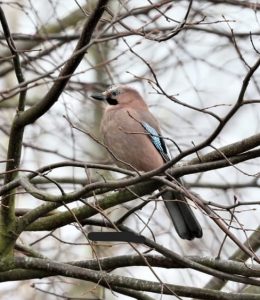
A Jay – Danny Carmichael
The corvids make a major contribution to the birdlife of the site. The jay is a really noisy bird as it squawks at you through the trees and if you are lucky, you will be able to see its very colourful plumage.
Magpies, always present, can be seen in large numbers (over 150 on one memorable occasion!). During the winter months, large flocks of jackdaws (400-600 at a time) have been seen congregating in the trees up the slope at dusk. They frequently make excursions to the Childwall woods, but with such numbers, it is almost impossible to count the carrion crows that mix in with them. Throughout the year, crows are almost always seen in ones and twos or slightly more, all over the site. Ravens are also being recorded on the site.
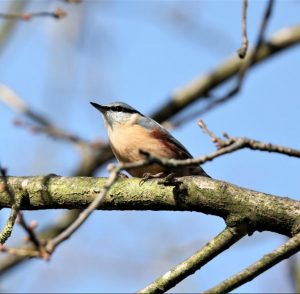
Nuthatch – Danny Carmichael
Even though the nuthatch is frequently heard during the spring, you will be fortunate indeed to catch sight of one. The treecreeper is even more secretive and has a very high-pitched song that is difficult to pick up.
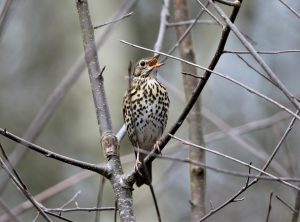
Song thrush – Danny Carmichael – Feb 21st 21
Male song thrushes spend the entire breeding period (Feb to July) with their repetitive songs marking their territories. As many as six at a time can be located spread over the site. We now hear them singing as early as December rather than February as before.
Woodpigeons are guaranteed and sometimes gather together in their tens, whilst on one occasion more than 200 were seen in the poplars on the top field!
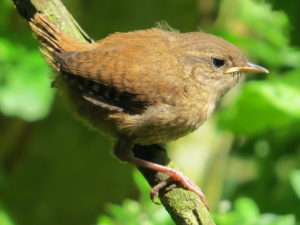
A young wren – October 2019 – Michael Barlow Winner of the Photography Competition 2019
The cheery little wren frequently sings at you from the shrubbery close by throughout the breeding season (lucky you if you see it!) and then, like the robin, goes silent for a couple of months.
The summer migrant visitors are represented by four warblers. The first one to arrive is the chiffchaff around 19th March, almost to the day each year.
The blackcap comes in early April, followed a week or so later by the whitethroat. The willow warbler has been heard and bred here in 2025, and swifts and swallows have been spotted overhead.
One winter migrant that visits Childwall Woods and Fields is the redwing, which can be seen throughout the woods and fields. And very occasionally its relative, the fieldfare can be seen. Other winter visitors include the small finches, siskin and redpoll, feeding with the more common chaffinch and goldfinch on the seeds of alder and birch trees. Even the tiny goldcrest is now known to be a winter visitor from the continent.
Whilst the birds that show up in numbers hold the interest for the observer, it is the species making single or rare appearances that add extra excitement. Occasionally a house sparrow can be heard in the trees by the concrete path near the TV studio car park, or along Childwall Lane. Britain’s commonest garden bird is rarely seen here.
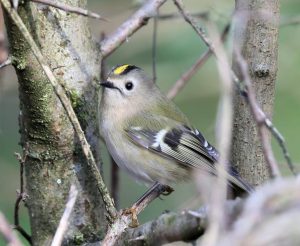
Goldcrest – Feb 2021 – Danny Carmichae
Bullfinch, goldcrest, kestrel, sparrowhawk may also be observed across the site.
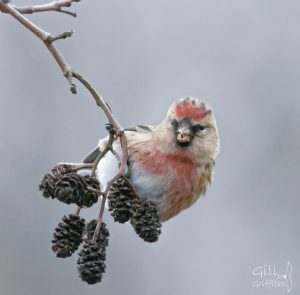
Redpoll – Feb 2021 – Gill Griffiths
The tawny owl is known to be present on the site, though rarely seen because it is nocturnal. Its calls are unmistakeable and its pellets, found under its favourite roosts, have given us an interesting insight into the small mammals such as mice and voles found here.
Finally, we reach the odd-balls, the ones that you would not expect to see like cormorants and kingfisher. And what was a pheasant doing in the plantation on the middle field?. What next? Expecting the unexpected is part of the fun of birding!
Authors: David G Holland & Andrew Scott
To see a gallery of beautiful photographs taken on the site, visit
The Photo Gallery