A dozen FCWF members joined Andrew Scott on Sunday for a Winter Nature Walk, taking a circular route through the beechwood and around the top field back to Countisbury Drive. It was a fascinating discovery of trees, birds, early flowers, lichen and fungi; nature is thriving despite the winter gloom, cold and wet – if you know how and where to look.
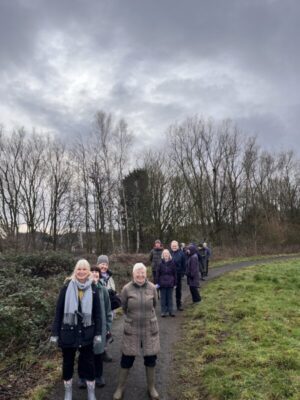
The bare trees enabled us to look at the structure of the wood – the way that trees, despite their competition for light, leave a respectful space between themselves and their neighbours – so-called ‘crown shyness’. And below the bare crowns, the evergreen understorey of holly, yew and rhododendron continues to grow even in the low winter light.
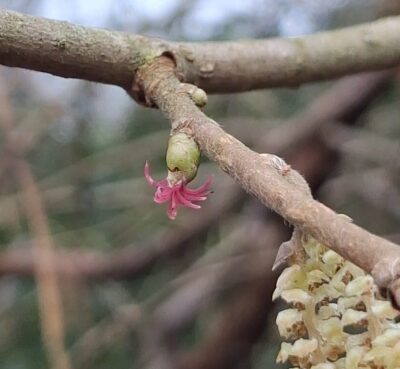
Without the leaves to aid recognition, we were forced to examine the bark, buds and shapes of trees to identify them: the smooth bark of beech with their long pointy buds, the gnarly bark of oaks with their zigzag branches, and the sprouty trunks of limes. On the top field we examined the catkins, cones and buds of alders, birch, hazel and willows. Already the willows are coming into flower and elder and hawthorn into leaf. In total we looked at a dozen families of common trees found in Childwall Woods and Fields. Below is the tiny female flower of hazel with its pink styli – far less showy than the male catkins. (Photo Brenda Cameron)
The birds too were making themselves known – with song thrush, robin, nuthatch, stock dove and greenfinch in fine voice. Added to the early bird song was the scream of jays, the drumming of woodpeckers, and the calls of flocks of tits moving in the tree tops. Paul recorded 22 species of birds on our walk.
Winter has not yet released its grip but with the early bird song, flowering bulbs, swelling buds and catkins, spring is on its way. But don’t just take my word for it, go and have a look for yourself! Below some spring bulbs (photo Paul Johnson).
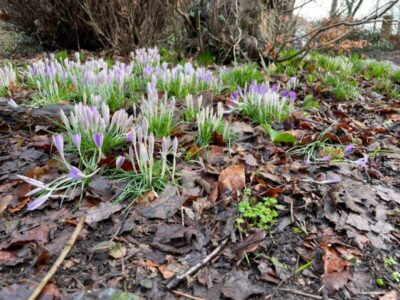
Many thanks to the members who joined us and to Brenda Cameron and Paul Johnson for their help and photos.
Andrew Scott