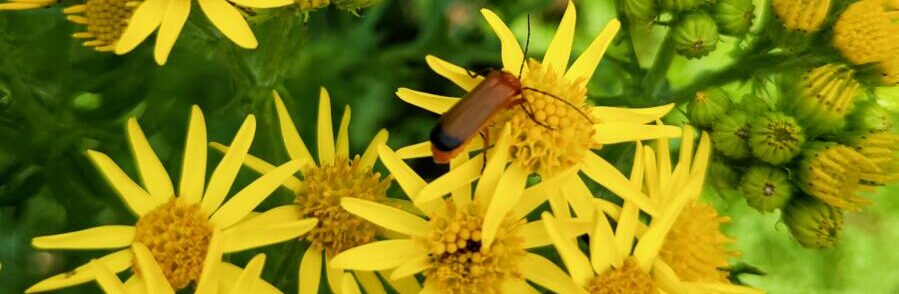

There are two types of amphibians at CWF – common frogs and palmate newts. Amphibian means ‘double life’ and refers to these animals’ ability to live both on land and in water.
They start life as soft jelly-like eggs in water which develop gills to breathe (tadpoles or newtlets). They then develop lungs and legs to live on land as adults. Their soft moist skin provides a secondary means through which adults can breathe. They are vertebrates (they have spines) and are cold blooded, that is their body temperature changes to match the surrounding air or water.
With their complex life cycles and permeable skins, amphibians are important and sensitive indicator species for environmental quality. And, as with so many species worldwide, their numbers are declining. This is why amphibians for us are important at CWF and why we take such care with our ponds.
Common Frog
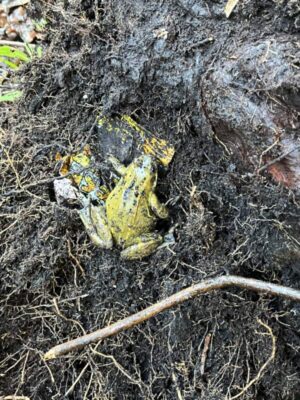
Common frog. Photo Andrew Scott
Frogs may start life in ponds and return there to breed but they spend most of their time as adults searching for their food of flies, slugs, snails and spiders in the undergrowth. They prefer moist conditions; this large adult was found in most soil under a rhododendron in the woods, a long way from the ponds.
They are most active between February and October and hibernate in winter under rocks or logs, or deep in the muddy bottom of ponds.
One of the things we are monitoring is the time of earliest appearance of frog spawn. With climate change we are noticing is that this is getting earlier.
Palmate Newts
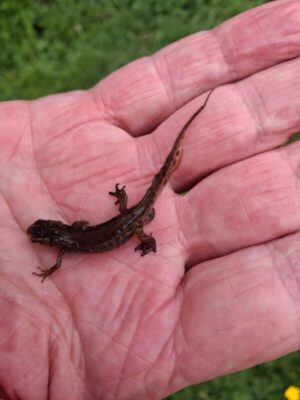
Palmate newt. Photo Brenda Cameron.
Our palmate newts are one of the main reasons why we were so keen to put in ponds at CWF.
The newts were present even before the ponds were dug!
They were living in the wet area near where the reed bed is on the top field, at the edge of the woodland, and breeding in a micro pond not much bigger than a bath. The least we could do was to give them a bigger home.
They are called palmate newts because the males develop webbed back feet during the breeding season. They have a distinctive orange or yellow belly and are the smallest of the UK’s 3 species of newts.
They feed on small aquatic invertebrates, freshwater shrimps and zooplankton and spend the winter months hibernating on land under stones or tree roots.
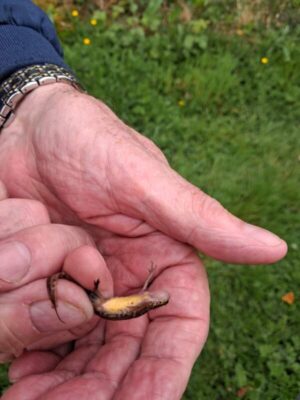
Photo Brenda Cameron.
Merseyside Biobank were rather surprised to be told we had these on site; they are unusual in this area and are normally found in acidic moorland ponds.