After the public Fungi Walk, 18 members joined Bren and Paul on another fungi hunt, not only finding new species but also hearing what the fungi were doing there.
Fungi play a very important role in the life of the woods. It is a cog in the wheel that supports all life, from the small creatures that feed on it to the trees that connect with it and will eventually be recycled by it.
Fungi have an essential role in the health of our woodlands, and this was discussed by members as they came across each species.
We saw the Turkey tail Tremetese versicola.

A pioneer species breaking down the bark to allow other species to colonise the wood.
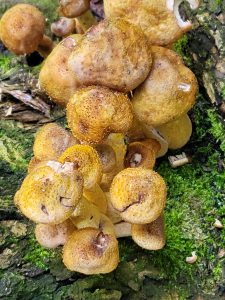
 We saw pathogenic and parasitic fungi, Honey fungus, Armillaria, that kill trees with their bootlace rhizomes and are killers throughout woods and gardens alike.
We saw fungi that were feeding on wood below the ground
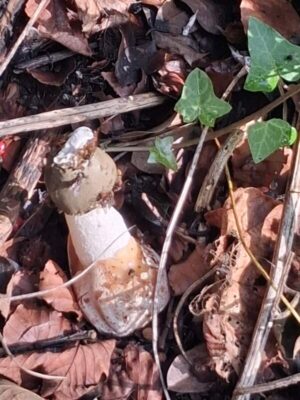
The Stinkhorn, Phallus impudicus, has a huge network of threadlike mycelium underground feeding on buried dead wood and producing horns of sticky black spores for the flies to feed on and carry away. The flies are drawn to them as they stink of rotting flesh,
There was the unusual White saddle that likes to be by paths.
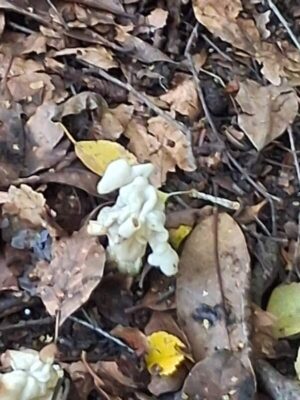
Helvella Crispa. Not often seen, but usually in leaf litter near paths, consuming nutrients it finds in the soil and leaf litter. A recycler.
After seeing 30 different species of fungi, all with essential roles to play in the life of the woods, we finished by looking at the fungi that hide within almost all of our oldest trees, eating them and hollowing them from the inside.
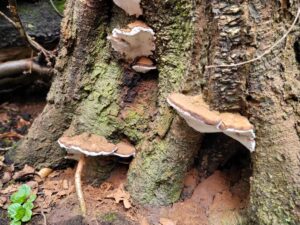
The Ganoderma Family of Heart rot fungi. Hollowing out our trees from the inside and creating irreplaceable habitats for thousands of species.
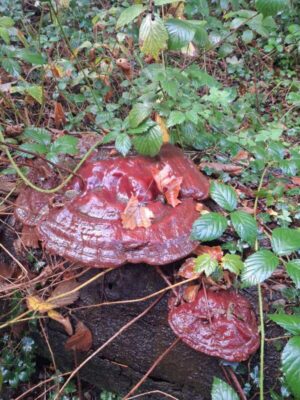
Ganoderma resinaceum, a rare therapeutic mushroom, 50cm across.
Author B Cameron
Event Leaders: B Cameron and P Johnson
The photographs are the authors’ own